
Review · CITY TOURS
Self-Guided Audio City Tour in Zurich
Zurich reveals itself on foot. This affordable audio walk links major sights with lesser-known stories, from Roman baths and guild buildings to Lenin’s former apartment and the birthplace of Dada. I especially like the freedom to set your own pace and the strong mix of art, politics, religion, and everyday city life. The main catch is that the walk can take much longer than the advertised two to three hours, and you need a reliable phone connection.
I also like the route’s clear photos and written captions, which help when a street sign is hard to spot. The audio adds useful context to landmarks that might otherwise blur together. Still, this is not a live tour, and a few people have had trouble with the link, playback, or navigation. Bring charged headphones, patience, and a little backup map sense.
In This Review
- Key points to know before you go
- Starting at Bahnhofplatz with Alfred Escher
- Lindenhof Hill and Zurich’s best pause
- St. Peter’s clock and the Roman baths
- Rathaus, Cabaret Voltaire, and Lenin’s Zurich
- Grossmünster, Wasserkirche, and Zwingli
- Opera House, Ganymed, and Hans Waldmann
- Fraumünster and the cost of going inside
- Augustinerkirche, Max Bill, and Weinplatz
- How the audio and navigation work
- Timing, walking effort, and the real value
- Who should choose this Zurich walk?
- Should you book this audio tour?
- FAQ
- How much does the Zurich audio tour cost?
- How long does the tour take?
- Where does the tour begin?
- Where does the tour end?
- Is a live guide included?
- What do I need to bring?
- Is entry to Fraumünster included?
- Can I complete the tour at my own pace?
- Can I cancel for a full refund?
Key points to know before you go
- Expect more than two hours: A brisk visit may fit the stated time, but stopping inside churches, reading captions, and pausing for views can stretch the walk to three and a half or four and a half hours.
- Start beside Zurich’s main station: The route begins at the Alfred Escher Statue on Bahnhofplatz and finishes near Max Bill’s Pavilion Sculpture on Bahnhofstrasse.
- History comes first: Roman baths, reformers, guilds, revolutionaries, and medieval leaders receive more attention than modern Zurich.
- Bring your own technology: You need a mobile phone with internet access and a headset. Battery life matters.
- Fraumünster costs extra inside: The church is part of the route, but interior admission is CHF 5 per person.
- The route is private by default: You explore alone or with your own group, without a live guide setting the pace.
Starting at Bahnhofplatz with Alfred Escher
The walk begins at Bahnhofplatz, a practical location beside Zurich’s main railway station. That makes it easy to reach, especially if you have just arrived in the city or want a first outing before checking into your hotel.
Your first stop is the Alfred Escher Statue. Escher was a major Swiss politician and industrial figure whose work helped shape the country’s economy and railway network. The brief stop gives you an early lesson in how closely Zurich’s prosperity is tied to transport, finance, and civic leadership.
Next comes Pestalozzianlage and its monument to Johann Heinrich Pestalozzi. Pestalozzi’s ideas changed education, so this small park introduces a different side of Swiss public life. The stop is short, but it helps balance the grander monuments with a reminder that social reform can be just as important as political power.
The nearby Urania Observatory adds a change of subject. Its focus is the night sky rather than city politics or church history. It is one of the route’s quick visual pauses, and you may appreciate the variety before the walk turns fully into Old Town.
More self-guided routes in Zürich:
- Zurich City Tour with Audio Commentary
★ 4.0 · 372 reviews - Einstein in Zurich: Walk in Time Exploration Game and Tour
★ 4.0 · 25 reviews - Self-Guided Audio Tour to the Dark Side of Zurich
★ 4.5 · 14 reviews
Lindenhof Hill and Zurich’s best pause

Lindenhof Hill is one of the route’s strongest stops. From this elevated point, you get views across the old city and toward the Limmat River. It is the kind of place where I would pause longer than the suggested ten minutes, especially if you want to get your bearings.
The audio points out the Hedwig Fountain, the Masonic Lodge, and the Tombstone of Lucius Aelius. Those details give the overlook more purpose than a simple photo stop. You are not just looking down at rooftops. You are connecting the view with local stories, architectural clues, and traces of an older Zurich.
The route is at its best here because the information stays tied to what you can see. That matters on an audio tour. If the narration wanders too far from the street around you, it becomes easy to tune out. At Lindenhof, the setting and the story work together.
St. Peter’s clock and the Roman baths
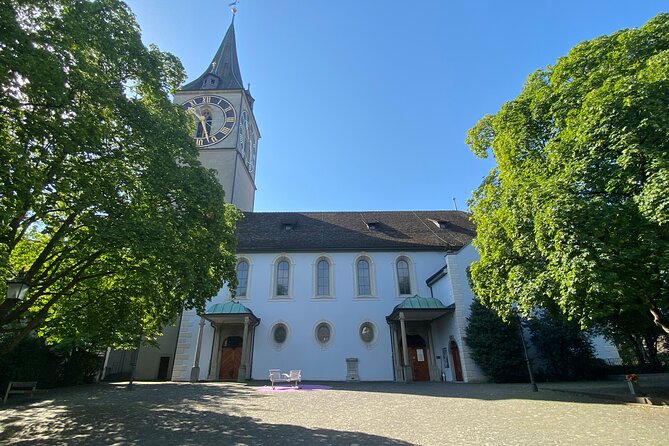
St. Peter’s Church is a major historical stop. It is identified as Zurich’s oldest parish church, and its giant clock face is the obvious feature from outside. The clock is one of the largest in Europe, so look up before you enter or move on.
Inside, the church offers a quieter break from the streets. The suggested ten minutes is enough for a quick look, but you can stay longer if the doors are open and you want a moment of calm. The audio gives the church religious and civic context, though the route’s focus on churches may feel heavy if you prefer modern culture or architecture.
Thermengasse follows with a much smaller but important site: the remains of Zurich’s ancient Roman baths. These traces connect the present city with Roman-era life. Do not expect a huge archaeological complex. The value is in understanding that Zurich’s story began long before the banks, shopping streets, and polished facades seen today.
Rathaus, Cabaret Voltaire, and Lenin’s Zurich
The Town Hall, or Rathaus, brings the walk back to city government. Its importance lies in what it represents: Zurich’s political life and the institutions that guided the city over time. This is a short stop, but it helps explain why the old center contains so many official buildings alongside churches and guild halls.
Cabaret Voltaire changes the mood completely. This is the birthplace of Dada, the early twentieth-century art movement known for challenging accepted ideas about art and culture. The stop is especially worthwhile if you enjoy modern art, literature, or stories about people who made a living by questioning the rules.
The Lenin Apartment adds another surprising layer. Vladimir Lenin lived in Zurich during political exile, and the stop considers the period when he used the city as a temporary home while thinking about ideas that later changed world politics.
These two locations show one of the walk’s real strengths: Zurich is not presented only as a medieval center. You also get politics, radical art, and international history. The drawback is that each stop lasts only about five minutes, so you will need to read or listen carefully if you want to retain the details.
More audio tours:
- Historical Zürich: A Self-Guided Audio Tour Through the city of 1,000 Fountains
★ 5.0 · 11 reviews - The Best of Basel’s Hidden Treasures: A Self-Guided Audio Tour
★ 4.5 · 32 reviews - Revealing Lucerne: Self-Guided Audio City Tour
★ 4.0 · 20 reviews - Self-Guided Audio City Tour in Bern
★ 4.0 · 17 reviews
Grossmünster, Wasserkirche, and Zwingli
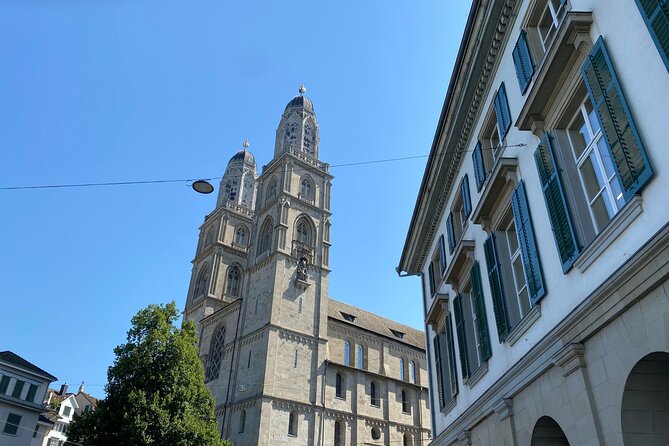
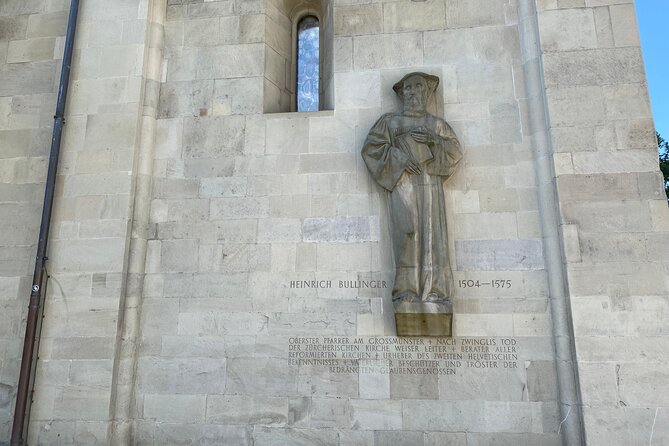
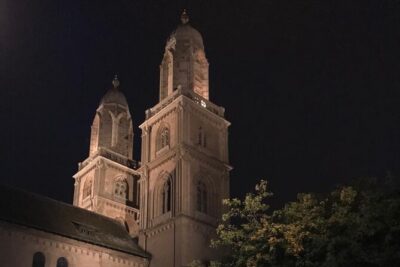
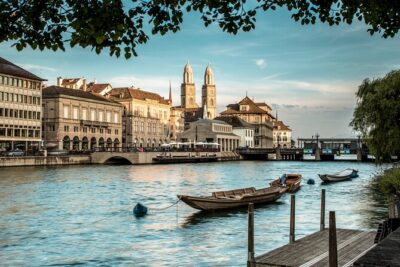
Grossmünster is likely to be one of the route’s headline sights. Its twin towers shape Zurich’s skyline, and its connection to the Swiss Reformation gives it major historical weight. The audio explains the church’s role in the religious changes led by Ulrich Zwingli.
Inside, look for the stained glass by Augusto Giacometti. The windows bring color and modern artistic energy into an old religious setting. The suggested fifteen-minute stop is longer than most on the route, and it deserves the extra time.
Wasserkirche sits close to the Limmat River. Its stained-glass windows provide another visual pause, though the visit is shorter. The church’s riverside position helps you shift from grand Reformation history to a more intimate look at Zurich’s sacred spaces.
The Ulrich Zwingli Monument continues the Reformation story. The statue honors the thinker and preacher who helped shape Swiss Protestantism. If you are interested in how religion affected politics, education, and public life, this group of stops gives you a useful foundation.
If you are less interested in church interiors, you can move quickly. That flexibility is one reason the audio format works well. You are not holding up a group, and you can skip a stop without losing access to the rest of the route.
Opera House, Ganymed, and Hans Waldmann
The route then heads toward Opernhaus Zurich. Composer and writer busts decorate the facade, making the building both a performance venue and a public tribute to artistic achievement. The short narration gives you a reason to study the exterior instead of simply passing by.
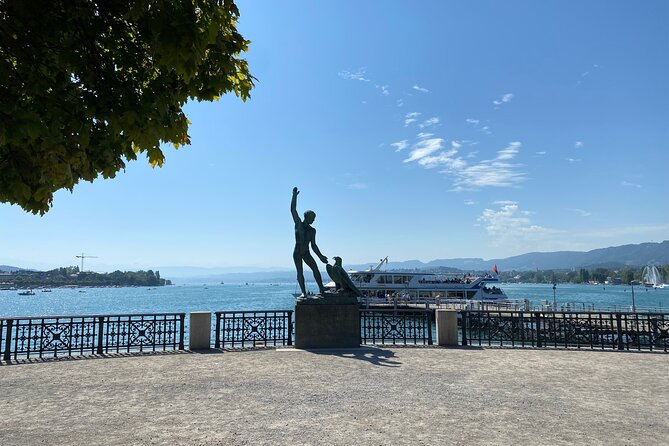
The Ganymed sculpture brings mythology and public art into the walk. Its subject comes from an old myth, but the point is the meeting of sculpture, story, and city space. It is a compact stop that helps prevent the route from becoming a sequence of churches and political monuments.
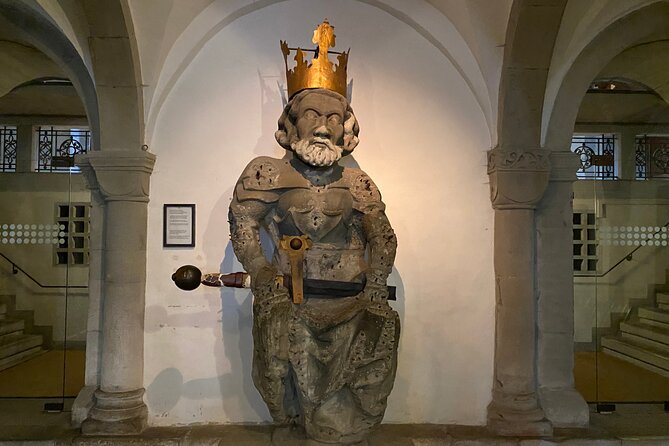
The Hans Waldmann Statue offers one of the more dramatic personal stories. Waldmann rose from modest beginnings to become Zurich’s burgomaster and one of its strongest political figures. His career ended with a death sentence, giving the statue a darker edge than its formal appearance might suggest.
This portion is useful for visitors who like individual stories. Large historical movements can feel abstract. A single figure who gained power, faced opposition, and met a tragic end gives the city’s past a human scale.
Fraumünster and the cost of going inside
Fraumünster is a key stop, but it is the one place where your ticket does not cover interior admission. Entry costs CHF 5 per person if you choose to go inside.
The reason to pay is clear: the church contains stained-glass windows designed by Marc Chagall. Sunlight passing through the glass creates the main visual experience, so an exterior look will not give you the full value of the stop. If you are watching your budget, you can admire the building from outside and continue. At $13.29 for the whole audio tour, paying CHF 5 for one major interior can still be reasonable for art lovers.
The audio route also brings you to Paradeplatz, Zurich’s financial center. This square shows the city’s modern identity: banking, commerce, and central-city energy. The contrast with Fraumünster, medieval churches, and Roman remains is one of the best features of the overall route.
Augustinerkirche, Max Bill, and Weinplatz
Augustinerkirche is quieter and simpler than the larger churches. Its modest appearance makes it a useful pause after the more famous Grossmünster and Fraumünster. You can expect a brief look at another part of Zurich’s religious past without the same visual demands.
The Max Bill Pavilion Sculpture on Bahnhofstrasse is the official endpoint. Bill’s work is presented as a symbol of transparency, equality, and freedom. The modern design provides a sharp contrast to the old churches, fountains, and guild buildings seen earlier.
The route also includes Weinplatz and the Millers’ and Bakers’ Guild Building. This stop shifts attention from rulers and reformers to working people. Guild buildings help you picture how trades shaped old Zurich and how ordinary occupations fitted into the city’s social order.
The endpoint beside Max Bill’s sculpture is not far from the city’s main shopping and transport areas. That makes it easy to continue exploring after the audio finishes, though you should note the route does not return you to the station.
How the audio and navigation work
After booking, you receive a link for the audio guide. You use your own phone and headset, with no live guide present. The material includes professional narration, photos, written captions, and directions between points.
The written transcript is especially useful. You can read instead of listening when the street is noisy, your connection is weak, or the narration moves more slowly than you prefer. One practical advantage is that you can skip points, pause for food, or visit another shop or sight without needing to backtrack.
Navigation is mostly clear, but it is not foolproof. Some street signs are difficult to see, and one person had trouble finding the way without a map. I would keep the route photos open, confirm each stop before moving on, and save the start and finish points in your phone.
Audio playback has also caused problems for some users. A link may need troubleshooting at the beginning, and unstable internet can cause the recording to restart. Downloading is not listed as an option, so treat a solid connection as important rather than optional.
Charge your phone before starting. The walk can last several hours, and continuous audio, photos, and navigation use plenty of power. If your battery is already low, this is not the moment to begin.
Timing, walking effort, and the real value
The advertised duration is two to three hours, but that should be treated as a brisk estimate. You can complete the route faster if you skip interiors and move quickly. If you listen to every section, read the captions, take photographs, pause at Lindenhof, and enter the churches, plan on three and a half to four and a half hours.
The route covers a lot of ground in central Zurich. Comfortable walking shoes are a sensible choice. The experience is not physically described as difficult, and most people can participate, but the distance and number of stops can wear you down if you begin tired.
At $13.29 per person, the price is low for the amount of material included. You get a route through major sights, historical narration, directions, photos, and the ability to use the access for up to one year from purchase. That last point is valuable if you cannot finish in one day.
The best comparison is not with a free stroll. It is with the cost of a live private guide. This audio option gives you structure and context without paying for a person to accompany your group. You give up the chance to ask questions, but you gain privacy and control.
Who should choose this Zurich walk?
I would recommend it to first-time visitors who want quick orientation around Old Town and to independent walkers who dislike fixed schedules. It also suits history-minded people who enjoy moving from Roman remains to Reformation churches, Dada, revolutionary politics, guilds, and modern sculpture.
It works well for couples or families who want to stop for coffee, shopping, or photographs along the way. You can pause the route instead of making everyone follow a guide’s timetable.
I would be more cautious if you want a lively personal storyteller, detailed modern history, or a tour built around questions and conversation. The content leans heavily toward early Zurich, churches, public monuments, and cultural history. It does not focus on World War II, bomb shelters, or every part of the city’s twentieth-century story.
Should you book this audio tour?
Book it if you want a low-cost, self-paced introduction to central Zurich and are comfortable managing your own phone, directions, and timing. The route offers far more than a list of famous buildings, and its strongest moments come from the unexpected links between Roman baths, Zwingli, Dada, Lenin, guild workers, and modern art.
Skip it if you need a live guide, a guaranteed offline audio system, or a short walk that ends back at the station. For everyone else, the price makes it a sensible first-day orientation, especially if you plan to spread the route across more than one outing.
FAQ
How much does the Zurich audio tour cost?
The listed price is $13.29 per person.
How long does the tour take?
The approximate duration is two to three hours, but it can take three and a half to four and a half hours if you listen to everything, stop often, and visit interiors.
Where does the tour begin?
It begins at the Alfred Escher Statue on Bahnhofplatz, beside Zurich’s main train station.
Where does the tour end?
It ends beside the Max Bill Pavilion Sculpture at Bahnhofstrasse 47, 8001 Zurich.
Is a live guide included?
No. The experience is self-guided, and you explore using the audio link provided after booking.
What do I need to bring?
You need your own mobile phone with internet access and a headset. A well-charged battery is also important.
Is entry to Fraumünster included?
No. If you want to enter Fraumünster, admission costs CHF 5 per person.
Can I complete the tour at my own pace?
Yes. You can pause, skip stops, spend extra time at sights, and continue later. Access is valid for up to one year from the purchase date.
Can I cancel for a full refund?
Yes, if you cancel at least 24 hours before the scheduled start time. Cancellations or changes made less than 24 hours in advance are not accepted for a refund.
Just added around Zürich
- Lake Zurich boat tour for an afternoon !★ 5.0 · 3 reviews
- 2 Hour Floating Harmony Couples Course★ 5.0 · 3 reviews
- Lake Zurich mini boat tour / by night!★ 5.0 · 3 reviews
- Central Switzerland (Private Tour)★ 5.0 · 3 reviews
- Wakeboarding Lake Zurich – afternoon !★ 5.0 · 3 reviews
- Private transfer from Zurich City to Basel Airport★ 5.0 · 3 reviews
- Jungfrau, Top of Europe & Interlaken Small group from Zurich★ 4.5 · 3 reviews
- Private Arrival Transfer: from Zurich Airport to Bern City★ 5.0 · 3 reviews
City Tours, compared.
Best of Geneva City Tour with optional boat cruise
Read our review →
City tour Zurich with the city whispers from CHF 21.00
Read our review →

Best of Zurich and Surroundings – Extended City Sightseeing Tour
Read our review →
Zurich Highlights City Tour with Optional FIFA Museum Ticket
Read our review →Browse the lists this tour appears in